
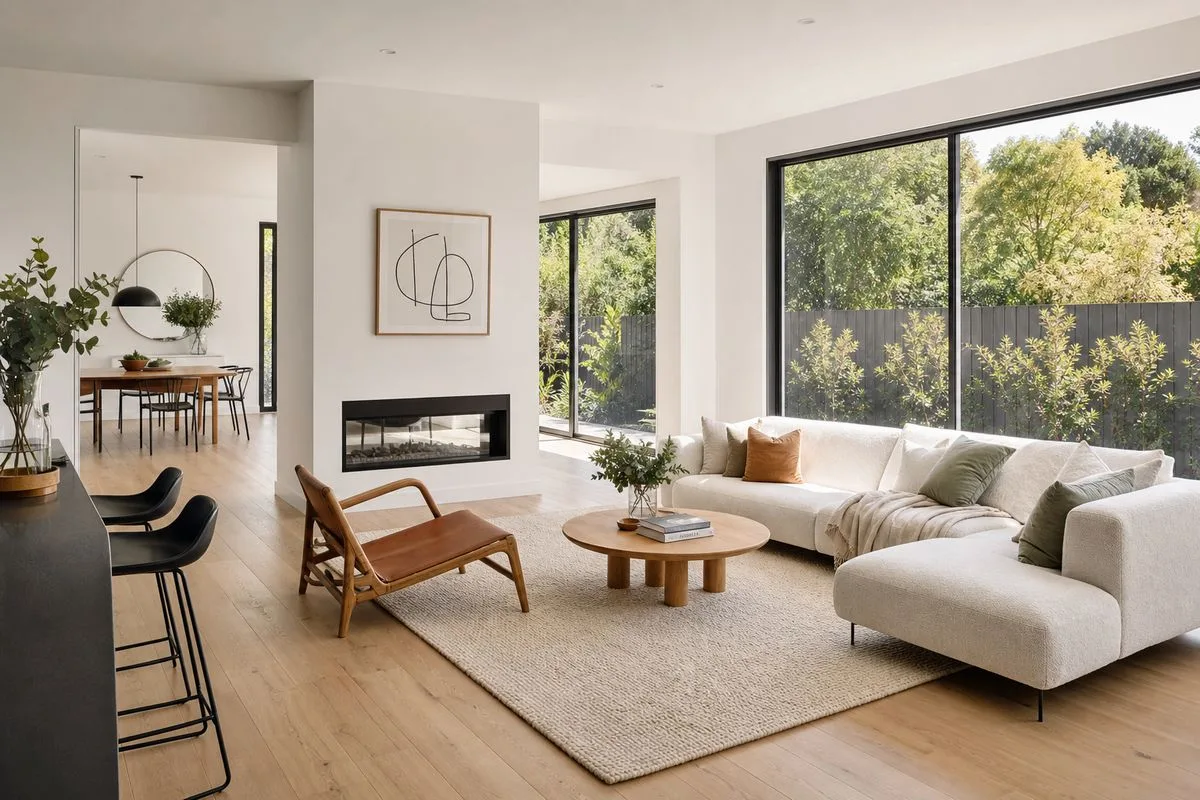
 There’s a reason we instinctively gravitate toward the sunlit corner of a café or linger by the window on a winter’s morning. Natural light isn’t just a design feature — it’s a fundamental ingredient of how we feel in a space. For Melbourne homeowners building a custom home, getting the light right from day one is one of the most impactful decisions you can make.
Why Natural Light Matters
Exposure to natural daylight regulates our circadian rhythms, lifts mood, and has been linked to improved sleep, productivity, and overall mental health. In a country that ranks among the world’s sunniest, it would be a missed opportunity to build a home that doesn’t harness that resource.
Beyond wellbeing, natural light has tangible financial benefits. Homes with well-considered daylighting require less artificial lighting and can significantly reduce heating costs when passive solar principles are applied — lowering your energy bills year-round. If you’re aiming for a green or sustainable home design, optimising natural light is one of the most cost-effective strategies available. Well-lit homes also consistently achieve stronger resale values, with buyers willing to pay a premium for spaces that feel open, warm, and alive.
Design Strategies That Make a Difference
Great daylighting starts at the design stage, not as an afterthought. Several proven architectural strategies work together to flood a home with light throughout the day.
Orientation is the foundation of passive solar design. In Melbourne, living areas ideally face north to capture the low winter sun and benefit from the deep roof overhangs that shade them in summer. East-facing rooms receive gentle morning light, while west-facing rooms can become uncomfortably hot in summer afternoons without careful shading.
Window placement and size work hand-in-hand with orientation. High-set windows, or clerestory windows positioned near the roofline, allow light to penetrate deep into a room without compromising wall space or privacy. They’re particularly effective in living areas, hallways, and stairwells that might otherwise feel dim. Skylights serve a similar purpose, especially in bathrooms, laundries, and internal rooms that lack external wall access. A well-placed skylight can transform a dark corridor into a bright, welcoming passage.
Open-plan layouts allow light to travel through a home rather than being trapped behind closed doors. Removing solid walls between the kitchen, dining, and living areas — and replacing internal partitions with glazed panels or screens — lets a single northern window illuminate multiple zones at once.
Melbourne-Specific Considerations
Melbourne’s latitude of approximately 37.8° south means the sun tracks noticeably lower across the sky in winter than in summer. On the winter solstice, the sun rises north of east and sets north of west, sitting much lower on the horizon — which is actually an advantage for passive solar heating if your living areas face north with adequate glazing. However, it also means that neighbouring buildings, fences, and vegetation can cast long shadows across your property during winter months.
South-facing rooms present a genuine challenge in Melbourne — they receive little to no direct sunlight year-round. Bedrooms and secondary spaces are better placed on the southern side, while living areas should be kept north or east-facing wherever the site allows.
Overshadowing is a real planning consideration in Melbourne’s inner and middle suburbs. The Residential Development Standards under the Victorian Planning Provisions include provisions (known as ResCode) that limit the extent to which a new build or extension can cast shadows over neighbouring habitable rooms and private open space. These rules work both ways — understanding how neighbouring structures affect your site at different times of year is essential before finalising window locations and room layouts.
Balancing Light With Privacy in Inner Suburbs
In Melbourne’s inner suburbs — Fitzroy, Northcote, Hawthorn, Richmond, and countless others — blocks are narrow, homes sit close together, and street frontages are tight. Getting more light in without putting your living room on display to neighbours requires considered design.
Clerestory windows are one of the most effective tools here — positioned above eye level, they bring in generous light while maintaining complete privacy. High-set obscure glazing in bathrooms and utility rooms serves the same function. On the street-facing facade, you might opt for smaller, carefully proportioned windows with deep reveals, while opening the rear of the home generously with full-height glazing onto a private courtyard or garden. Lightweight screens, louvres, and perforated screens can also filter light beautifully while acting as a visual barrier from neighbours or the street.
Interior material choices amplify whatever light you do bring in. Pale timber floors, white or light-toned walls, and highly reflective ceiling finishes bounce natural light deep into a room, making even a modest window feel generous.
Heritage Homes: Getting Light Into Period Properties
Melbourne’s Victorian, Edwardian, and interwar homes are beloved for their character — their ornate facades, high ceilings, and original joinery. But many were designed for a different era of living, with a series of small, compartmentalised rooms that can feel dark and disconnected from modern family life.
Sensitive extensions and renovations can introduce significant amounts of natural light without disturbing the heritage character of the original structure. The key is to treat the rear of the home as a contemporary addition — pulling down or glazing rear walls, introducing a north-facing extension with full-height windows, adding skylights to the connection between old and new, and creating an open-plan kitchen and living area that flows to an outdoor space.
Planning overlays — particularly Heritage Overlays — may restrict what’s visible from the street, but generally allow considerably more flexibility at the rear and roof of a property. A skilled designer familiar with Melbourne’s heritage planning environment can find genuine opportunities to flood even the most traditional home with modern, generous daylighting. Whether you’re working with a period home or starting fresh with a knock-down rebuild, the same light-first principles apply.
The Energy Efficiency Connection
Natural light and thermal performance go hand in hand. Getting passive solar design right — the right amount of north-facing glass, correctly sized roof overhangs, thermal mass in floors and walls — means your home heats itself in winter and resists overheating in summer without relying heavily on mechanical systems. This is the basis of genuinely energy-efficient custom home design that reduces running costs for decades to come, not just at handover.
Getting this balance right requires upfront analysis — sun path modelling, shadow diagrams, and thermal simulation — rather than guesswork on site. It’s exactly the kind of work that should happen before a single footing is poured.
How AHH’s Design-Build Process Optimises Natural Light From Day One
When you build a new custom home with Australian Heritage Homes, natural light isn’t treated as a box to tick — it’s embedded into the design conversation from the first site visit. As a third-generation Melbourne builder, AHH’s team brings deep familiarity with how light behaves across Melbourne’s varied suburbs, block shapes, and orientations.
The integrated design-build process means the architects and builders work together from the beginning. There’s no handover gap where a beautifully designed home loses its passive solar logic in translation to the construction team. When the designer specifies a high-set clerestory window or a precise roof overhang depth, the builder understands exactly why it’s there and how to execute it correctly.
AHH brings that same generational knowledge to heritage restoration and extension projects, understanding both the planning constraints and the opportunities available to bring more light into Melbourne’s treasured period homes — without sacrificing their character or integrity.
If you’re planning a custom home or major renovation in Melbourne and want to explore how to make the most of natural light on your site, the AHH team is ready to help you get it right from day one.