
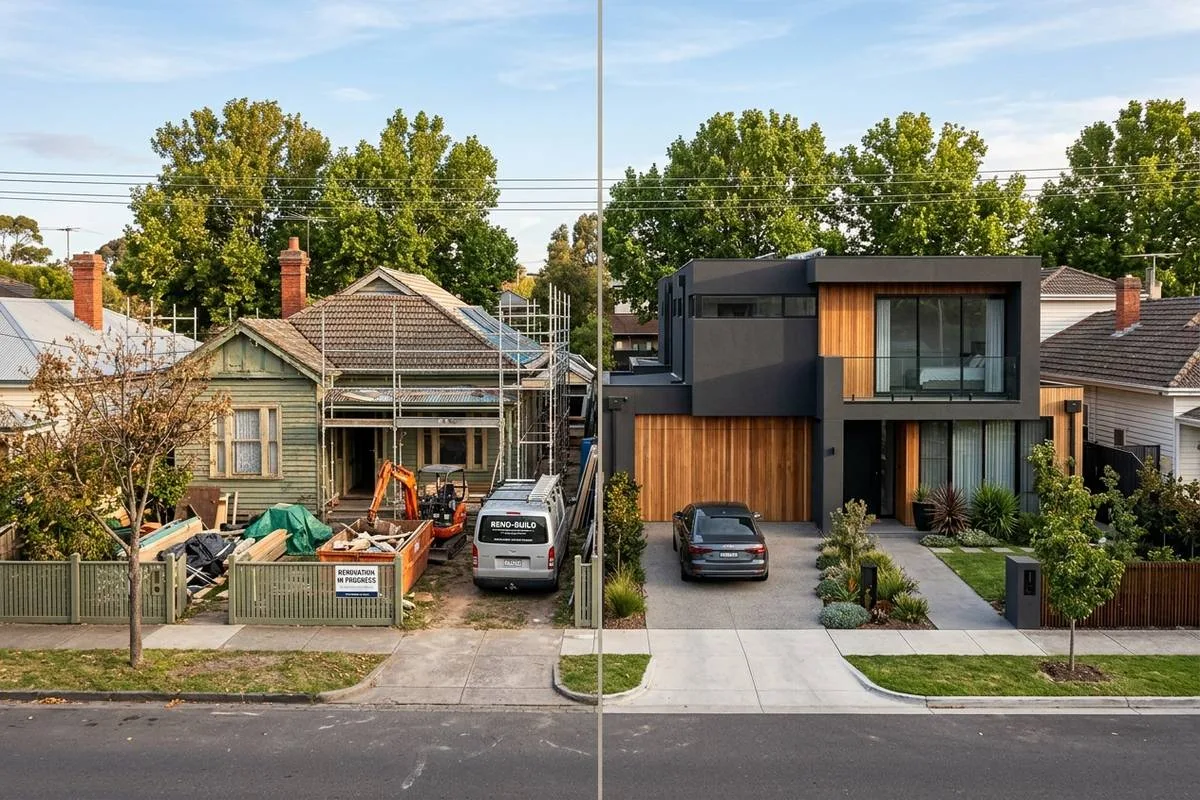
 It’s one of the biggest decisions a Melbourne homeowner can face: do you keep what you have and renovate, or is it time to knock it down and start fresh? There’s no universal right answer — and anyone who tells you otherwise probably hasn’t spent much time looking at the extraordinary variety of homes across Melbourne’s suburbs. From century-old Edwardian terraces in Fitzroy to 1970s brick veneer homes in Glen Waverley, every property tells a different story and demands a different approach.
At Australian Heritage Homes, we’ve been helping Melbourne families navigate exactly this decision for over 40 years. We’ve seen the full spectrum — beautiful heritage homes brought back to life, and tired, structurally compromised properties that simply made more sense to rebuild. Our advice is always honest, and it always starts with understanding your specific situation.
When Renovation Makes Sense
Renovation is often the right choice — and not just for sentimental reasons. There are genuinely practical situations where working with your existing home delivers the best outcome.
Your home has heritage or character value. Melbourne’s inner suburbs are filled with homes that sit within heritage overlays — think Northcote, Williamstown, Carlton, or Hawthorn. If your home is covered by a heritage overlay or sits in a neighbourhood character precinct, council will likely restrict or prevent demolition. In these cases, thoughtful renovation isn’t just the preferred path — it may be the only one. Our expert renovation services are built specifically around preserving the character of these homes while adding modern liveability.
The bones are good. A home with solid structural foundations, sound framing, and a layout that mostly works is a strong candidate for renovation. If you’re looking to add a rear extension, modernise a kitchen, or open up living areas without major structural changes, the cost and disruption of a full rebuild isn’t warranted.
Your scope is manageable. Single-storey additions, bathroom upgrades, kitchen transformations, or a new deck — these are renovations that deliver excellent value without the complexity and cost of a full knock-down rebuild. If your project is focused in scope, renovation is typically faster and more cost-effective.
Budget favours renovation. If the work you need done comes to significantly less than the cost of a comparable new build, renovation is the sensible financial choice — particularly in established suburbs where land value is high and the cost of a new build may not be recouped in resale value.
When a Knock-Down Rebuild Is the Better Option
For many Melbourne homeowners — particularly those in outer suburbs like Ringwood, Frankston, Craigieburn, or Berwick — a knock-down rebuild is not just viable, it’s genuinely the smarter path forward.
Significant structural issues. If your home has major foundation problems, serious termite damage, hazardous materials throughout (like asbestos sheeting, which is common in homes built before 1990), or a frame that’s well past its useful life, the cost of rectifying these issues can quickly make renovation uneconomical. Sometimes the kindest thing you can do for your family — and your budget — is start fresh.
The layout doesn’t work and can’t be fixed. Some homes were simply designed for a different era. Choppy floor plans with poor natural light, low ceilings, cramped bedrooms, and inadequate indoor-outdoor flow can be incredibly difficult and expensive to transform through renovation. A rebuild gives you the freedom to design a home that genuinely works for your family’s life — not just the family that lived there in 1965.
Extensive renovation costs are approaching new build pricing. This is a crucial crossover point that many homeowners don’t anticipate. When you start tallying up the full scope of a major renovation — structural work, re-roofing, rewiring, re-plumbing, new insulation, kitchen, bathrooms, and extensions — the total can edge surprisingly close to a new build. At that point, a knock-down rebuild often makes more sense: you get a brand-new home with a builder’s warranty, modern energy efficiency, and no hidden surprises. Explore our knock-down rebuild services to see what’s possible on your block.
You want to maximise your block’s potential. If you’re on a larger block in the middle or outer suburbs, a rebuild allows you to design a home that makes the most of your orientation, views, and outdoor space in a way that’s simply not achievable by retrofitting an existing structure.
Cost Comparison: What You’re Really Signing Up For
One of the most common mistakes homeowners make when comparing options is taking renovation quotes at face value. Renovation budgets have a well-earned reputation for blowing out — and not because builders are dishonest. It’s because older homes have a habit of revealing surprises once walls come down: asbestos that needs professional removal, rusted plumbing that needs full replacement, or structural issues that weren’t apparent from a surface inspection.
A knock-down rebuild, by contrast, offers much greater pricing predictability. You’re working from a clean slate — known materials, known construction methods, and a fixed-price contract. There are no hidden horrors lurking behind plaster walls. This predictability is one reason why many families who’ve done extensive research end up choosing the rebuild path.
That said, renovation has its own cost advantages — particularly if you can retain existing plumbing and electrical infrastructure, preserve structural elements, or work in stages over time. The key is getting accurate, comparable quotes that account for the full scope of each option — not just the obvious work.
It’s also worth reading our post on common mistakes homeowners make when planning a custom build — many of these apply equally to major renovations and can help you avoid costly planning errors regardless of which path you choose.
Council and Planning Considerations in Melbourne
Melbourne’s planning framework is genuinely complex, and it varies significantly from one municipality to the next. Before you commit to either path, it’s essential to understand what your local council will and won’t allow.
Heritage overlays — common in councils like Boroondara, Stonnington, Port Phillip, and Moreland — can prevent or significantly restrict demolition of existing homes. Neighbourhood character overlays add another layer of requirements around design, scale, and materials for new builds. Some councils actively encourage medium-density redevelopment; others are fiercely protective of established streetscapes.
A knock-down rebuild also requires a demolition permit, and in some areas, a heritage impact statement before any work can begin. For renovations, planning permits may be required for extensions that exceed certain heights or setbacks. None of this is insurmountable — but it needs to be factored into your timeline and budget from the outset.
The Australian Heritage Homes Approach
What sets AHH apart is that we genuinely do both — and have done both for over four decades. We’re not a knock-down rebuild specialist who’ll push you towards demolition regardless of your circumstances, nor are we a renovation-only firm who’ll convince you to renovate a home that’s really past its prime.
When you engage with us, we start with an honest, detailed assessment of your property, your goals, and your budget. Our initial design and build process is specifically designed to get all the relevant information on the table early, so you can make an informed decision with confidence — not guesswork.
Our third-generation experience across Melbourne’s suburbs means we’ve seen almost every combination of block, building, council, and client circumstance. We know when renovation will deliver a beautiful, lasting outcome, and we know when the kindest advice we can give is to start fresh. We take pride in giving you that honest guidance regardless of which option suits our business better.
If you’re thinking about materials and finishes for a new build or major renovation, our post on choosing the right materials for a long-lasting custom home in Melbourne offers practical guidance on making selections that will stand the test of time.
Key Questions to Help You Decide
If you’re still weighing up your options, these questions can help clarify your thinking:
- Is my home in a heritage overlay? If yes, demolition may not be permitted — check with your council first.
- What’s the structural condition of my existing home? Have you had a full building inspection by a qualified inspector?
- Does the layout of my home fundamentally work? Or are the problems so deep that no renovation will truly fix them?
- What does my renovation scope actually cost — fully scoped? Have you accounted for potential asbestos removal, re-plumbing, rewiring, and structural unknowns?
- What could I build new for the same money? Get a ballpark rebuild quote alongside your renovation quote for a genuine comparison.
- How long do I plan to stay in this home? A rebuild is often a better long-term investment if you’re planning to stay for 15+ years.
- What does the street and neighbourhood allow? Check with your local council about overlays, setbacks, and character requirements.
Ready to Make the Right Call?
There’s no shortcut to making this decision well — it requires good information, honest assessment, and the guidance of people who’ve seen it all before. Whether you end up renovating your existing home or building something entirely new, the most important step is talking to a builder who can give you a clear picture of both paths.
At Australian Heritage Homes, that’s exactly what we offer. We’re here to help Melbourne families make the right choice for their home, their budget, and their future — not just the choice that suits us. If you’re ready to explore your options, we’d love to hear from you.