
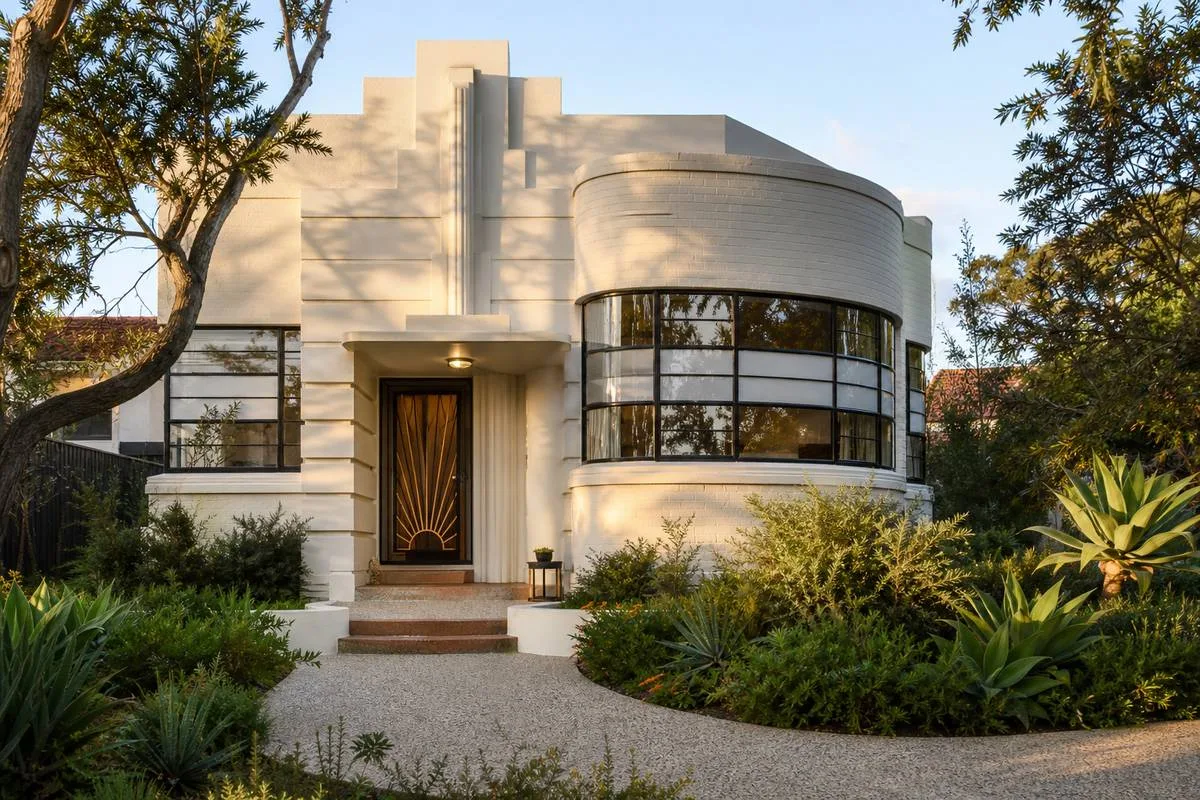
 Drive through Elwood, Moonee Ponds or Caulfield on a clear Melbourne morning and it’s impossible to miss them — bold, geometric facades with curved corners, stepped parapets and crisp rendered brick. Melbourne’s Art Deco and interwar homes, built through the 1920s and 1930s, represent one of the city’s most distinctive architectural eras. At Australian Heritage Homes, our third-generation team has spent more than 40 years helping Melbourne families bring period character to life in new custom builds and knock-down rebuilds, and Art Deco is among the most exciting styles we work with.
What Defines an Art Deco Home?
The interwar period — roughly 1918 to 1940 — produced a housing style that broke sharply from the ornate fussiness of Victorian and Edwardian architecture. Art Deco drew on modernist geometry while retaining a sense of crafted luxury. The hallmarks most commonly seen across Melbourne’s interwar streetscapes include:
- Curved corners and bowed bays — the single most recognisable feature, often seen wrapping a front corner or accentuating a sunroom or entry vestibule.
- Rendered brick or cream/pale stucco facades — smooth, flat surfaces were a deliberate contrast to the decorative pressed iron and timber of earlier styles.
- Geometric and stylised ornamentation — sunburst motifs, stepped or zigzag parapets, chevron and floral reliefs above doors and windows.
- Steel-framed Crittal-style windows — slim, black-framed casements and horizontally banded glazing that flooded interwar interiors with light while reinforcing a machine-age aesthetic.
- Flat or low-pitched rooflines — often hidden behind a parapet, giving the home a strong horizontal silhouette from the street.
- Decorative friezes and cornices — often in a contrasting render or tile detail that frames eaves and entries.
Internally, Art Deco homes embraced rich materials — leadlight glass in geometric patterns, terrazzo floors, curved plasterwork ceilings and built-in joinery with chrome or brass hardware. Colour palettes leaned towards creams, terracottas, deep greens and warm blacks, often combined for dramatic effect.
Where to Find Melbourne’s Finest Interwar Streets
Melbourne’s interwar housing boom was concentrated in the middle-ring suburbs that were opened up by the expansion of the tram and rail network through the 1920s and 30s. Some of the most intact Art Deco streetscapes include:
- Elwood — arguably Melbourne’s finest concentration of interwar flat-roofed and bayed homes, particularly along Ormond Esplanade and surrounding streets, with many properties under Port Phillip Council’s Heritage Overlay.
- Moonee Ponds and Ascot Vale — Moonee Valley Council manages a large number of individually significant interwar properties across this area, including notable streets near the Maribyrnong River.
- Caulfield and Carnegie — Glen Eira Council has extensive heritage overlays protecting intact interwar streetscapes, with Art Deco flats and detached houses sitting side by side.
- Hawthorn and Camberwell — Boroondara Council’s heritage register includes a substantial number of high-quality interwar homes in these leafy suburbs, often on generous blocks.
- Coburg and Brunswick — Merri-bek Council’s interwar residential precincts preserve a grittier, working-class expression of the style, with simpler rendered facades and original steel windows.
If your property sits within one of these areas, it is worth checking whether a Heritage Overlay applies before planning any changes. Our team has extensive experience navigating council heritage requirements, and we’ve written a practical guide to heritage overlays for Melbourne homeowners that explains what the planning controls mean in plain language.
Recreating Art Deco Character in a New Custom Build
One of the most rewarding aspects of our work at Australian Heritage Homes is designing and building new homes that genuinely capture the spirit of the interwar era — not as a shallow pastiche, but as a considered interpretation that weaves period character into modern living. Whether you’re starting from scratch on a fresh block or undertaking a knock-down rebuild on a site in Elwood or Moonee Ponds, there are reliable strategies for achieving an authentic Art Deco result.
Facades and street presence: We work with specialist rendered masonry and bricklayers to achieve the clean, flat planes and crisp reveals that define a genuine interwar look. Curved corner returns require custom formwork and are one of our signature capabilities. The roofline is typically concealed behind a stepped parapet with contrasting render banding — a detail that rewards close attention to proportion.
Windows and glazing: Steel-framed Crittal-style windows from Australian suppliers dramatically elevate interwar character. We pair them with deep external reveals for strong shadow lines. Internally, we often incorporate geometric leadlight panels — handcrafted by local Melbourne glaziers — into entry halls and stairwells.
Interiors: Terrazzo floors, stepped cornices and built-in joinery with fluted pilasters and chrome hardware are all elements we design into new builds for homeowners wanting the full interwar experience. Our initial design and build process includes detailed specification review so these finishes are resolved before construction begins — not as afterthoughts.
Balancing Period Authenticity with Modern Comfort
Recreating an Art Deco home doesn’t mean sacrificing modern comfort. Thermally broken steel window frames eliminate the condensation issues of original single-glazed Crittal windows, while high-performance insulation sits behind rendered walls that look every bit as crisp as their 1930s counterparts. Hydronic underfloor heating beneath terrazzo or encaustic tile is a particularly natural pairing — radiant warmth and a finish that looks exactly right in an interwar home. Passive solar orientation, high-thermal-mass walls and generous north-facing glazing are all consistent with the Art Deco aesthetic and contemporary energy design. Our green and sustainable home design service has been applied to a number of Art Deco-inspired builds across Melbourne’s inner suburbs.
Art Deco in Renovations and Extensions
Not every project starts with a blank site. Many Melbourne families own an existing interwar home that needs updating. Our renovation and extension team is experienced in working sensitively within the envelope of an existing Art Deco home — matching render profiles, sourcing period-compatible hardware and designing additions that step back respectfully from the original facade. We’ve completed projects across Elwood, Caulfield and Hawthorn where the original facade has been meticulously restored while the rear has been opened up with contemporary glazing and open-plan living. For those comparing whether to extend or start fresh, our guide to knock-down rebuild versus renovate sets out the key questions to work through.
Start Your Art Deco Build Conversation
Art Deco is one of Melbourne’s great architectural inheritances, and bringing its character into a new home or thoughtful renovation is deeply satisfying work. If you’re drawn to the geometric elegance of the interwar era and want to explore what that might look like in your next home, we’d love to hear about your project. Explore our recent project portfolio for inspiration, or get in touch with the Australian Heritage Homes team to start the conversation.